What is Benchmarking and why it is important for Senior Management?
Results of our Benchmarking Study on Indian FMCG Sector + How to identify wastes in Office?

Most leadership teams spend significant time reviewing financial statements, budgets, and business forecasts. But one important question often remains unanswered:
“How do we compare with the best in our industry?”
This is where benchmarking becomes indispensable.
Benchmarking is the systematic process of comparing an organization’s performance with industry peers and market leaders to identify performance gaps, uncover best practices, and set realistic improvement targets. It moves discussions from assumptions to facts and provides senior management with an external perspective on operational performance.
Financial performance is the outcome of operational excellence. Metrics such as productivity, inventory turns, capacity utilization, quality, supply chain efficiency, and working capital determine how effectively a business converts its resources into profits. By benchmarking these operational indicators, leadership can identify where the organization is leading, where it is falling behind, and where strategic investments will create the greatest impact.
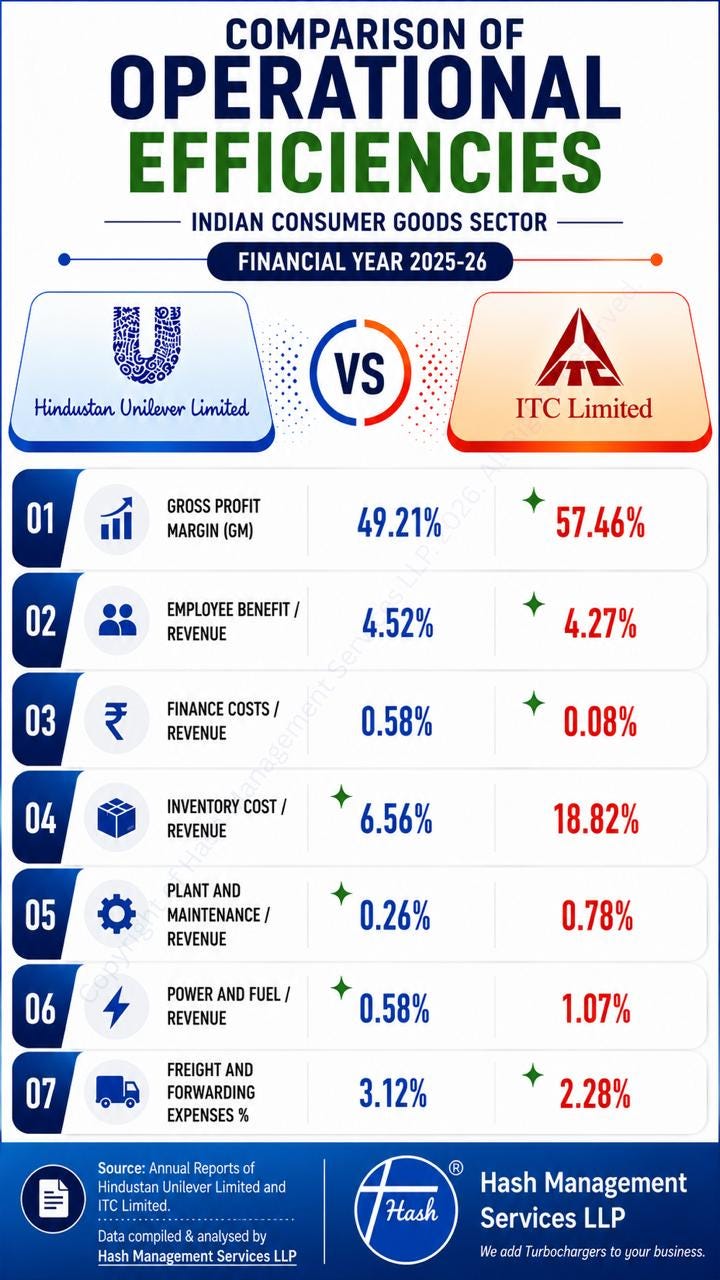
We did a benchmarking study of Operational Efficiency for Indian FMCG Sector and here are the results:
Plant and Maintenance cost is 0.78% for ITC, whereas for HUL it is only 0.26%. ITC has more than 250 own factories, 12 Integrated facilities (with warehouses) + paper mills and extensive manufacturing assets, compared to 26 Asset Light factories of HUL . This may be a reason for higher maintenance cost.
ITC’s Gross margin is 57.66% (8% higher) than HUL’s 49.21%. Both the companies are strengthening their FMCG core, value-added adjacencies, premiumisation, digital supply chain and Portfolio sharpening (shared in the Annual Report.
Employee cost is almost the same.
Finance Cost is 0.58% for HUL, whereas ITC spends only 0.08% as Finance Cost
Inventory cost is high for ITC (18.82%), whereas for HUL it is only 6.56%. No specific reason we could find in the annual report, but may be ITC handles more agri, paper and other related products that needs more inventory storage / handling.
Power and Fuel costs is just 0.58% for HUL, whereas ITC spends 1.07%. HUL specifically mentions that their 97% of power requirement comes from renewable energy (45MW Solar Park), whereas ITC gets only 51% from renewable sources.
ITC has excellent digital Omnichannel Distribution, AI Powered Logistics platform, 50 Warehouses across India (near the demand centres) - resulting in 2.28% as freight and forwarding expenses. HUL spends 3.12% in freight cost.